



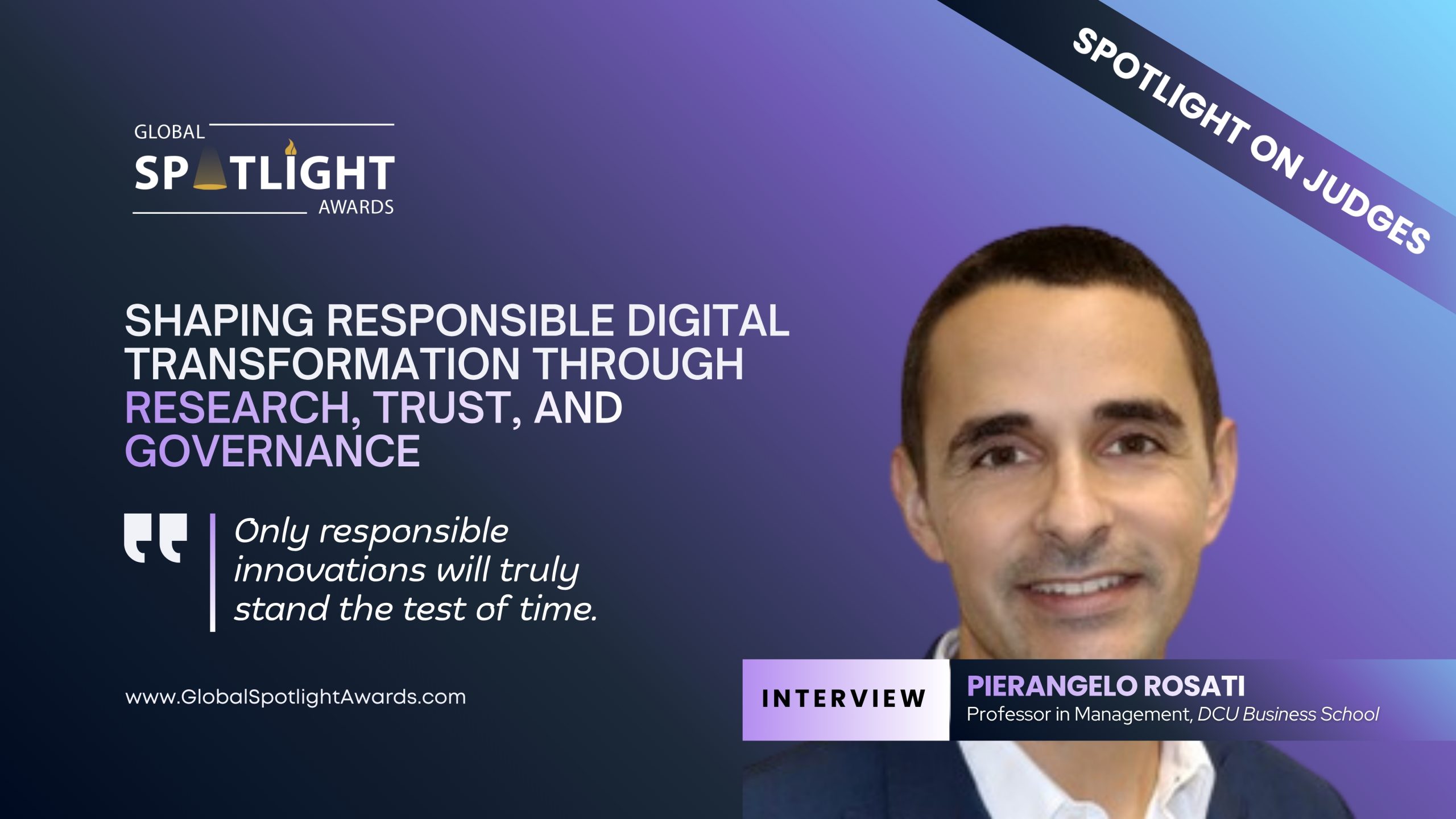
Spotlight On Judges: Insights from Pierangelo Rosati,Professor in Management, DCU Business School
As part of the Global Spotlight Awards 2026, the Spotlight on Judges Series introduces the experts behind the judging process, those shaping what excellence looks like across technology, AI, data, and cybersecurity.
In this edition, we speak with Pierangelo Rosati, a Professor in Management and Director of Industry Engagement at DCU Business School, where he leads postgraduate applied consultancy projects, and has responsibility for embedding industry engagement throughout the School’s taught programmes. Building on previous roles at Dublin City University and the University of Galway, his work bridges research, teaching, and practice to support organisations navigating digital transformation.
His research examines both the business value and societal implications of digital technologies, with a particular focus on data analytics, cybersecurity, digital sustainability, technology acceptance, and the digital transformation of towns and cities. He is also a Funded Investigator at Lero, the Science Foundation Ireland Research Centre for Software.
Through his work connecting academia, industry, and policy, he brings a research-driven, analytical, and impact-focused perspective to the Global Spotlight Awards 2026 judging panel.
What does global excellence mean within your field today, and how does it relate to the mission of the Global Spotlight Awards 2026?
Global excellence for me means combining creative thinking with systematic opportunity scouting and designing solutions that can operate at scale from day one. It requires the ability to move from ideas to action, and the drive and persistence to iterate and improve continuously. This understanding aligns closely with the mission of the Global Spotlight Awards 2026, which aims to recognise initiatives that are not only innovative and globally relevant but also scalable, sustainable, and capable of delivering meaningful impact.
What inspired you to join the Global Spotlight Awards 2026 judging panel, and what value do you believe you bring to the evaluation process?
I was inspired to join the judging panel because I genuinely enjoy seeing new and innovative ideas and understanding how people have turned them into reality. As an academic, I place particular emphasis on the quality of the assumptions underpinning an idea and the depth and robustness of the research that supports it. I also have extensive experience in applied research and a strong appreciation of how it can translate into tangible business impact. I believe I bring this analytical perspective, along with a focus on relevance, feasibility, and impact, to the evaluation process.
How does responsible innovation align with the vision and purpose of the Global Spotlight Awards?
In my view, only responsible innovations will truly stand the test of time. Increasingly, people and organisations pay close attention to how innovations are implemented, and whether they respect individuals, communities, and society more broadly. By placing responsibility at the core of its criteria, the Global Spotlight Awards reinforces the idea that successful innovation is not just about novelty or technological sophistication, but about creating positive, sustainable outcomes for people and society.
What role does governance, ethics, and trust play in defining global excellence in digital transformation?
Governance, ethics, and trust are now fundamental dimensions of global excellence in digital transformation. Technological capabilities are advancing at an unprecedented pace, and we are experiencing one of the most significant waves of innovation in human history. As we push the boundaries of what technology can do, it is inevitable that things will occasionally break or have unintended consequences. It is therefore essential to have clear, responsible, and ethical guardrails in place to test new technologies, understand their implications, and refine them before they are rolled out more widely within organisations. Strong digital governance and robust digital ethics are, in my view, critical organisational capabilities for achieving trustworthy and sustainable digital transformation.
How do you evaluate whether innovation is both technologically advanced and socially responsible?
I look first at the underlying design principles of the innovation and at the rigour of the governance processes surrounding it. These elements reveal a great deal about whether the innovation has been conceived and developed with a genuine intent to create societal value, or whether it is primarily driven by short-term profit. Evidence of thoughtful stakeholder engagement, clear risk assessment, transparency, and accountability mechanisms all indicate that an innovation is not only technologically advanced but also socially responsible.
How can global recognition platforms like the Global Spotlight Awards influence policy, research, and industry collaboration?
Global recognition platforms such as the Global Spotlight Awards can play a powerful role in shaping expectations and behaviours across ecosystems. By recognising responsible innovations rather than solely rewarding technological sophistication, they raise awareness of the importance of responsibility, ethics, and impact, and give these values visibility and legitimacy. This, in turn, can incentivise other stakeholders to follow similar principles. Over time, such initiatives can contribute to a virtuous circle in which responsible innovation is increasingly rewarded and emulated, helping to influence managerial mindsets, inspire new lines of academic and applied research, and foster more effective collaboration between policymakers, industry, and academia.
Closing the Spotlight
Pierangelo Rosati’s perspective highlights a critical dimension of the Global Spotlight Awards 2026 judging panel: innovation must be both impactful and responsible to deliver lasting value.
His focus on governance, research rigour, and societal impact reinforces the importance of solutions that are not only innovative but also sustainable, trustworthy, and aligned with real-world needs. As the awards continue to recognise leaders across technology, AI, data, and cybersecurity, insights like these ensure the judging process remains grounded in accountability, relevance, and long-term global impact.
About the Global Spotlight Awards 2026
The Global Spotlight Awards recognise individuals and organisations delivering measurable impact across artificial intelligence, technology, data, and cybersecurity. The programme highlights innovation that solves real-world challenges, improves systems, and drives meaningful progress at scale. Through a clear and independent judging process, the awards showcase work that demonstrates strong execution, proven results, and lasting value. By recognising those setting new standards in innovation and performance, the Global Spotlight Awards contribute to a more advanced, secure, and data-driven global future.


