



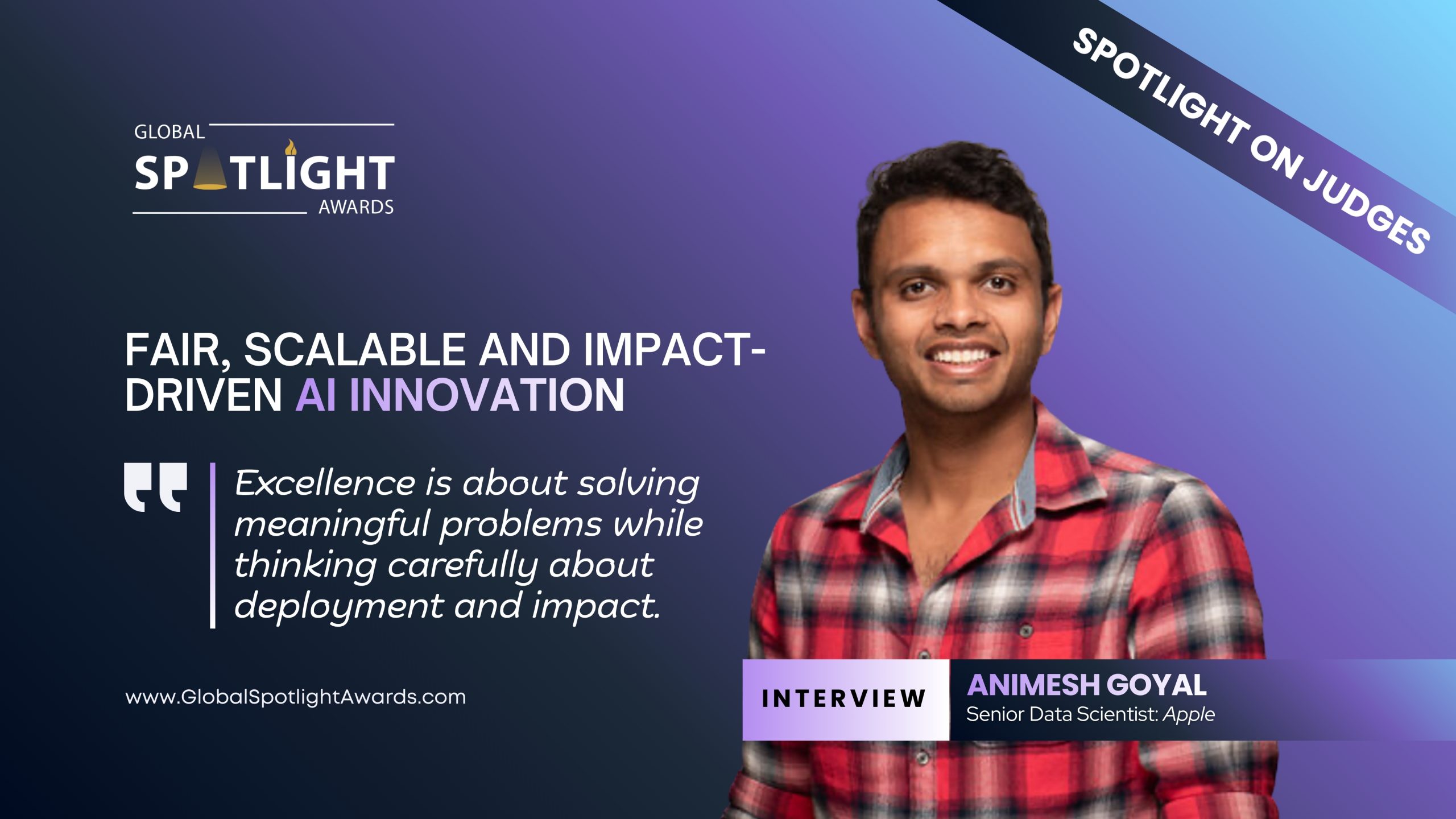
Spotlight on Judges: Insights from Animesh Goyal, Senior Data Scientist, Apple
As part of the Global Spotlight Awards 2026, the Spotlight on Judges Series introduces the experts behind the judging process, those shaping what excellence looks like across technology, AI, data, and cybersecurity.
In this edition, we speak with Animesh Goyal, Senior Data Scientist at Apple, whose perspective is shaped by deep expertise in applied machine learning, AI-driven product development, and scalable data systems.
Animesh Goyal is a Senior Data Scientist specialising in applied machine learning, data science, and AI-driven product development, with a strong foundation in operations research and industrial engineering. His work focuses on translating complex data and advanced analytical methods into scalable, real-world solutions across large digital platforms.
He has extensive experience designing and evaluating end-to-end machine learning systems, including customer journey analytics, experimentation and A/B testing, behavioural modelling, decision intelligence, and production-grade model deployment.
Operating at the intersection of data, engineering, and product, Animesh ensures solutions are technically rigorous, scalable, reliable, and grounded in measurable impact. He holds a Master of Science from the University of Texas at Austin and an engineering degree from BITS Pilani, and has also contributed to innovation evaluation panels focused on structured, impact-driven assessment of technology.
What does global excellence mean within your field today, and how does it relate to the mission of the Global Spotlight Awards 2026?
Global excellence in data science and AI today means creating solutions that are technically rigorous, practically deployable, and ethically responsible. Excellence isn’t just about achieving state-of-the-art accuracy on a benchmark, it’s about understanding the real-world constraints that define whether a system can actually be useful: latency, interpretability, fairness across populations, and computational efficiency. The Global Spotlight Awards align perfectly with this perspective because they celebrate work that balances innovation with pragmatism. The best entries I see aren’t the ones that sacrifice everything for a marginal performance gain; they’re the ones that solve meaningful problems while thinking carefully about deployment and impact. That’s what global excellence looks like in 2026.
What inspired you to join the Global Spotlight Awards 2026 judging panel, and what value do you believe you bring to the evaluation process?
I was drawn to the Global Spotlight Awards because they genuinely celebrate diverse voices and approaches across the industry. As someone who has worked across academia, startups, and Fortune 500 companies, I see how much the field benefits when we recognise excellence wherever it emerges. My perspective spans machine learning infrastructure, natural language processing, operations research, and applied AI in large-scale systems, and I bring a specific lens to judging: a focus on whether solutions actually work in production environments.
I also care deeply about mentoring emerging talent and helping organisers identify work that might not get visibility otherwise. I want my participation to elevate entries that might be technically excellent but less polished in their presentation, and to push submitters to think beyond the conference circuit about what real-world impact looks like.
How do data science and AI innovation reflect the standards of global excellence celebrated by the Global Spotlight Awards?
The Global Spotlight Awards celebrate innovation that serves real needs, and that’s exactly what responsible data science and AI should do. Innovation in AI isn’t just about novel architectures or clever algorithms; it’s about asking the right questions: What problem are we solving? Who benefits? What are the failure modes? How do we know if this actually works?
The best work I’ve seen in my career, and the entries I’m most excited to champion, are ones where the authors have thought deeply about these questions. The Awards recognize that excellence comes from many vectors: methodological rigour, practical impact, and thoughtfulness about deployment. That diversity of recognition is crucial because it sends a signal to the next generation of practitioners that excellence isn’t one-dimensional.
What defines real-world impact in AI and machine learning beyond technical accuracy or model performance?
Technical metrics are necessary but never sufficient. Real-world impact comes from three things: adoption, sustainability, and trust. An algorithm with 99% accuracy that no one can implement or maintain has zero impact. Similarly, a system that works beautifully in a lab but fails silently or unfairly in production has caused harm, not impact.
I’ve seen this across my work at Apple and my previous roles, the projects that genuinely moved the needle were the ones that engineers could build on, that operations teams could monitor, and that users (or the people affected by the system) could understand and trust.
In my own research and work, I’ve always measured success by: Did this change how decisions are made? Did it solve a bottleneck that was actually limiting? Is it still being used two years later? Those are the questions that separate impact from academic exercise.
How do you approach evaluating fairness, scalability, and innovation when judging technical submissions for the Global Spotlight Awards?
I don’t evaluate these in isolation; they’re deeply interconnected. Fairness that doesn’t scale isn’t fairness, it’s a research prototype. Innovation that ignores fairness or scalability is irresponsible.
When I review a submission, I’m asking: Where are the tensions? If someone claims their system is innovative and fair, I want to see the evidence. What populations were they tested on? How did they define fairness, and what trade-offs did they accept? Is the approach reproducible by someone who isn’t the original author?
Scalability means both technical, can this handle real data volumes, and practical, can teams outside the authors’ organisation implement it? I also look for intellectual honesty. The best work I’ve encountered is transparent about limitations. Authors who say “we solved X, and here are three things we couldn’t solve yet” are already thinking at the level required for real impact. That thoughtfulness is what excellence looks like to me.
What emerging trends in AI and data science do you believe the Global Spotlight Awards community should pay attention to?
Three things.
First, the shift from benchmark-driven research toward systems that explicitly model real-world constraints. We’re moving away from “can we achieve this accuracy” toward “can we achieve this accuracy within these latency, cost, and interpretability budgets?”
Second, the maturation of causal inference and its application to real decision-making systems. Much of applied ML treats correlation as sufficient, but some of the most impactful work I’m seeing pushes toward understanding causation, which changes how we evaluate model decisions.
And third, the intersection of AI with operations research and domain expertise. The future isn’t just models and engineers, it’s models, engineers, and a deep understanding of the systems they’re optimising. I’m excited to see more work that brings operations researchers, domain scientists, and ML engineers into genuine collaboration. The Awards platform is perfect for surfacing that kind of integrated thinking.
Closing the Spotlight
Animesh Goyal’s perspective reinforces a central theme across the Global Spotlight Awards 2026 judging panel: true innovation is defined by how well it performs in the real world.
His focus on scalability, fairness, and production-grade reliability highlights the difference between experimental success and lasting impact. As the awards continue to recognise leaders across AI, data science, and technology, insights like these ensure the judging process remains firmly rooted in rigor, responsibility, and measurable value.
About the Global Spotlight Awards 2026
The Global Spotlight Awards recognise individuals and organisations delivering measurable impact across artificial intelligence, technology, data, and cybersecurity. The programme highlights innovation that solves real-world challenges, improves systems, and drives meaningful progress at scale. Through a clear and independent judging process, the awards showcase work that demonstrates strong execution, proven results, and lasting value. By recognising those setting new standards in innovation and performance, the Global Spotlight Awards contribute to a more advanced, secure, and data-driven global future.


