



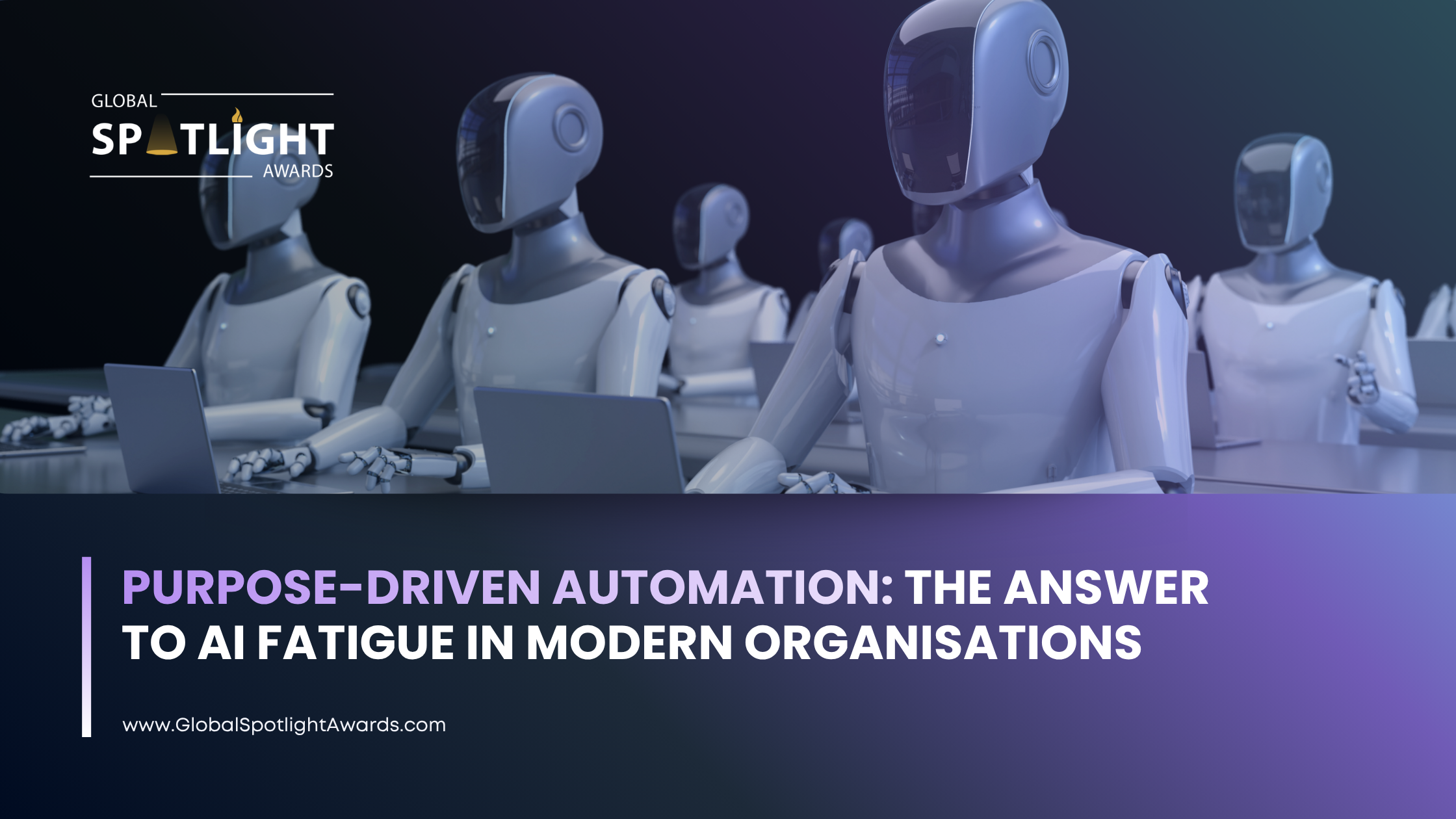
Purpose-Driven Automation: The Answer to AI Fatigue in Modern Organisations
Artificial intelligence is everywhere.
It writes content, analyses data, automates workflows, responds to customers, and increasingly influences how businesses operate. What was once considered a competitive advantage has rapidly become a standard expectation.
Yet as AI adoption accelerates, a new phenomenon is emerging: AI fatigue.
Organisations are discovering that automation alone is not the answer. More tools, more prompts, and more outputs do not automatically create more value. In many cases, they create noise.
At the Global Spotlight Awards, we recognise the innovators, leaders, and organisations redefining the role of AI in business. They are moving beyond automation for automation’s sake and embracing a more intentional approach: purpose-driven automation.
Because the future of AI is not about doing more. It is about doing what matters most.
The Rise of AI Fatigue
Over the last few years, businesses have rushed to integrate AI into every possible function.
Teams have been encouraged to automate tasks, experiment with generative tools, and accelerate productivity. While many of these initiatives have delivered meaningful benefits, they have also introduced new challenges.
Employees are navigating an overwhelming number of platforms, notifications, recommendations, and automated processes. Leaders are facing pressure to implement AI strategies without always having clear objectives behind them.
The result is a growing sense of fatigue.
Not because AI lacks potential, but because technology without purpose rarely delivers lasting impact.
From Automation to Intention
The first wave of digital transformation focused on efficiency.
The next wave is focusing on intention.
Forward-thinking organisations are beginning to ask different questions.
Instead of asking, “What can we automate?”
They are asking, “What should we automate?”
This shift is changing the conversation around technology adoption. Success is no longer measured by the number of AI tools deployed but by the value those tools create for people, customers, and businesses.
Purpose-driven automation starts with outcomes, not technology.
Human-Centred Innovation
One of the most important lessons emerging from the AI era is that technology works best when it amplifies human capability rather than replacing it.
The most successful automation strategies are designed to remove friction, reduce repetitive work, and create more space for creativity, collaboration, and critical thinking.
Employees do not want to spend less time being human.
They want more time to focus on meaningful work.
Purpose-driven automation recognises this reality by placing people at the centre of technological innovation.
Quality Over Quantity
For many organisations, AI implementation has become a race to adopt the newest tool.
However, maturity in AI strategy often looks very different.
It involves fewer tools, clearer objectives, stronger governance, and more deliberate integration.
Businesses are increasingly realising that sustainable innovation is not about generating more content, processing more data, or automating every process.
It is about improving the quality of decisions, experiences, and outcomes.
The question is no longer how much automation exists.
The question is whether it serves a meaningful purpose.
Trust Becomes the New Currency
As AI systems become more influential, trust becomes more valuable.
Customers, employees, and stakeholders want transparency around how automated decisions are made. They want reassurance that AI is being used responsibly, ethically, and fairly.
This has elevated trust from a compliance issue to a strategic priority.
Organisations that build trust into their AI strategies are creating stronger relationships, greater resilience, and more sustainable growth.
In an age of automation, trust may become the ultimate competitive advantage.
Redefining Productivity
For decades, productivity was measured primarily by output.
Today, leaders are beginning to recognise a more nuanced reality.
More output does not always mean more impact.
Purpose-driven automation encourages organisations to focus on outcomes rather than activity. It shifts attention away from how much work is being produced and toward the value that work creates.
This evolution is redefining what success looks like in the modern workplace.
The future belongs not to the busiest organisations, but to the most intentional ones.
The Future of Purpose-Driven Automation
Artificial intelligence will continue to evolve.
Automation capabilities will become faster, smarter, and more integrated into everyday operations.
But the organisations that thrive will not necessarily be those with the most advanced technology.
They will be the ones with the clearest purpose.
Purpose-driven automation represents a new stage in digital transformation where technology aligns with business goals, employee wellbeing, customer value, and long-term impact.
It is not about replacing people.
It is about empowering them.
Why We Celebrate These Innovators
Because the most influential leaders in AI are not simply building systems.
They are shaping how technology serves humanity.
They understand that innovation without purpose creates complexity, while innovation with purpose creates progress.
The Global Spotlight Awards recognise individuals and organisations that are using automation thoughtfully, responsibly, and strategically to create meaningful impact.
These are the innovators helping define a future where technology enhances human potential rather than overshadowing it.
Step Into the Spotlight
If your work is helping organisations implement AI with intention, improve experiences through intelligent automation, or create technology that delivers measurable impact, your story deserves recognition.
Join a global community of innovators, changemakers, and leaders shaping the future of purpose-driven automation.
FAQ – Frequently Asked Questions
1. What is AI fatigue?
AI fatigue refers to the growing sense of overwhelm caused by excessive reliance on AI tools, automation platforms, and constant technological change without clear purpose or value.
2. What is purpose-driven automation?
Purpose-driven automation is the intentional use of AI and automation technologies to achieve meaningful business outcomes while supporting employees, customers, and organisational goals.
3. Why are organisations moving toward purpose-driven automation?
Many businesses are recognising that simply adopting more AI tools does not guarantee better results. Purpose-driven approaches focus on measurable impact rather than technology adoption alone.
4. Does purpose-driven automation replace human workers?
No. Its primary goal is to enhance human capability by reducing repetitive tasks and enabling people to focus on higher-value work that requires creativity, judgement, and collaboration.
5. Why is trust important in AI adoption?
Trust is essential because stakeholders need confidence that AI systems are transparent, ethical, fair, and aligned with organisational values.
6. Why does this matter for recognition?
Because the leaders driving responsible and purposeful AI adoption are helping shape the future of work, innovation, and business performance on a global scale.


