



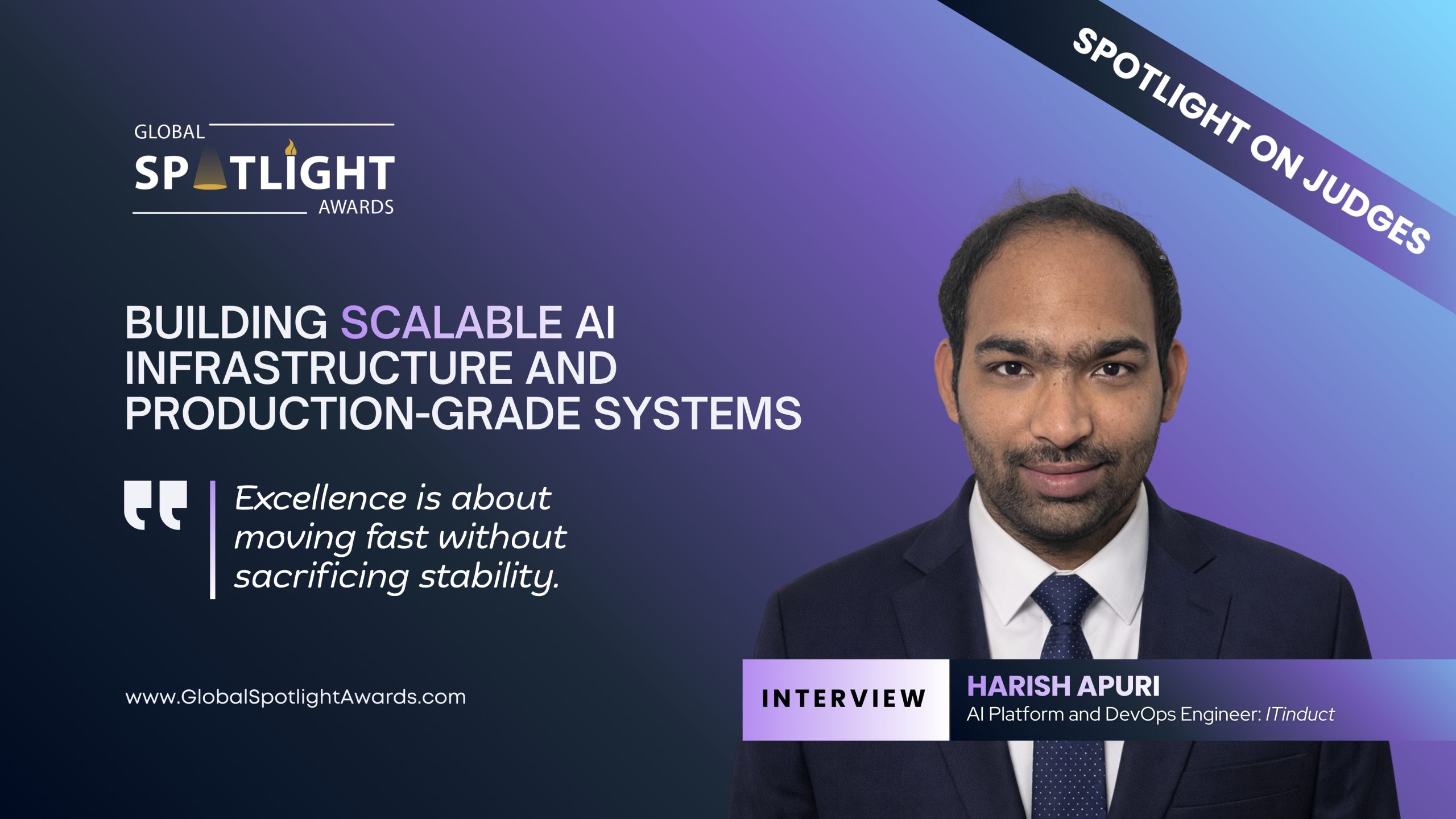
Spotlight on Judges: Insights from Harish Apuri, AI Platform and DevOps Engineer, ITinduct
As part of the Global Spotlight Awards 2026, the Spotlight on Judges Series introduces the experts behind the judging process, those shaping what excellence looks like across technology, AI, data, and cybersecurity.
In this edition, we speak with Harish Apuri, AI Platform and DevOps Engineer at ITinduct, whose perspective is shaped by deep expertise in scalable AI systems, cloud infrastructure, and production-grade machine learning engineering.
Harish Apuri is an AI Platform and DevOps Engineer with over five years of experience building scalable AI and cloud infrastructure across AWS, Azure, and GCP. He specialises in MLOps, Kubernetes, infrastructure automation, and deploying production-grade machine learning systems.
Operating at the intersection of AI systems and infrastructure engineering, Harish brings a highly technical, performance-driven perspective to the Global Spotlight Awards 2026 judging panel, focused on scalability, reliability, and real-world impact.
What does global excellence mean within your field today, and how does it relate to the mission of the Global Spotlight Awards 2026?
Global excellence in AI and cloud engineering today means building systems that are not only technically advanced but also reliable, scalable, and responsible across diverse environments. It’s about delivering infrastructure that performs consistently in production, creates real business value, and operates with strong governance and transparency.
The Global Spotlight Awards reflect this standard by recognising organisations that balance innovation with operational maturity. True excellence lies in the ability to move fast without sacrificing stability, to apply cutting-edge techniques while understanding their limits, and to scale globally while respecting local compliance. That intersection is exactly what these awards are designed to celebrate.
What inspired you to join the Global Spotlight Awards 2026 judging panel, and what value do you bring to the evaluation process?
The most meaningful awards distinguish between solutions that simply function and those that represent genuine breakthroughs in reliability, scalability, or innovation. I joined the judging panel because I believe in recognising work that achieves both technical sophistication and the operational discipline needed to sustain it.
What I bring to the evaluation process is a focus on substance over narrative. Beyond polished presentations, I look at how systems perform under real-world conditions, at scale, over time, and under stress. The organisations that stand out are those that have already solved the hard production challenges, not just demonstrated promising ideas.
How does scalable AI infrastructure and MLOps excellence contribute to the kind of global innovation recognised by the Global Spotlight Awards 2026?
Scalable AI infrastructure and MLOps are what transform AI from experimentation into sustained impact. Strong MLOps practices enable teams to iterate quickly, deploy reliably, and scale globally while maintaining governance and cost control.
Without that foundation, even the most advanced models fail in production. With it, organisations can monitor drift, automate retraining, and ensure consistent performance across regions and use cases. This operational backbone is what enables real, durable innovation, and it’s exactly the kind of capability the Global Spotlight Awards aim to recognise.
In your experience building production-grade AI systems across AWS, Azure, and GCP, what defines a truly reliable and high-impact AI platform?
A truly reliable and high-impact AI platform is defined by three dimensions: technical reliability, operational excellence, and business impact.
Technically, systems must handle failure gracefully, support fallback mechanisms, and provide deep observability across performance, cost, and fairness. Multi-region resilience and failover are essential at a global scale.
Operationally, excellence means infrastructure-as-code, automated testing, disciplined cost management, and documentation that stays aligned with reality.
Most importantly, high-impact platforms clearly connect technical performance to business outcomes. They incorporate feedback loops, continuously evaluate value versus cost, and address risks transparently. The platforms that succeed are those that bring all three dimensions together.
When evaluating innovation in AI and cloud engineering for the Global Spotlight Awards, what key technical and operational indicators do you look for?
When evaluating innovation, I focus on three areas: technical design, operational execution, and measurable impact.
From a technical perspective, I look for thoughtful architecture choices, strong system integration, and evidence that edge cases and failure modes are handled effectively. Claims should be backed by real benchmarks or production data.
Operationally, I assess how quickly and reliably teams move from concept to production, how well they manage failure isolation, and how efficiently they use resources. Long-term maintainability is critical.
In terms of impact, the strongest submissions demonstrate clear, measurable outcomes—whether in revenue, efficiency, or customer experience- and show that their approach is sustainable and scalable beyond a single use case.
How are AI agents, RAG pipelines, and automated infrastructure shaping the future of production AI systems at a global scale?
We’re seeing a major shift in how production AI systems are built. AI agents are enabling more flexible, multi-step workflows, moving beyond monolithic models toward systems that can reason, act, and recover dynamically.
RAG pipelines address the limitations of large language models by grounding them in real-time, verifiable data, making them far more reliable in domains where accuracy is critical.
At the same time, automated infrastructure is accelerating development while improving consistency and auditability. Infrastructure-as-code, CI/CD, and auto-scaling are becoming standard for high-performing teams.
The most advanced systems combine all three, agents orchestrating RAG pipelines on top of automated, scalable infrastructure. This convergence enables organisations to innovate while maintaining reliability and control, and it represents the frontier of global AI excellence.
Closing the Spotlight
Harish Apuri’s perspective underscores a defining theme across the Global Spotlight Awards 2026 judging panel: innovation must perform in the real world to truly matter.
His focus on scalability, reliability, and operational discipline highlights the difference between experimental success and production-ready impact. As the awards continue to recognise leaders across AI, technology, data, and cybersecurity, insights like these ensure the judging process remains grounded in real-world performance and long-term value.
About the Global Spotlight Awards 2026
The Global Spotlight Awards recognise individuals and organisations delivering measurable impact across artificial intelligence, technology, data, and cybersecurity. The programme highlights innovation that solves real-world challenges, improves systems, and drives meaningful progress at scale. Through a clear and independent judging process, the awards showcase work that demonstrates strong execution, proven results, and lasting value. By recognising those setting new standards in innovation and performance, the Global Spotlight Awards contribute to a more advanced, secure, and data-driven global future.


