



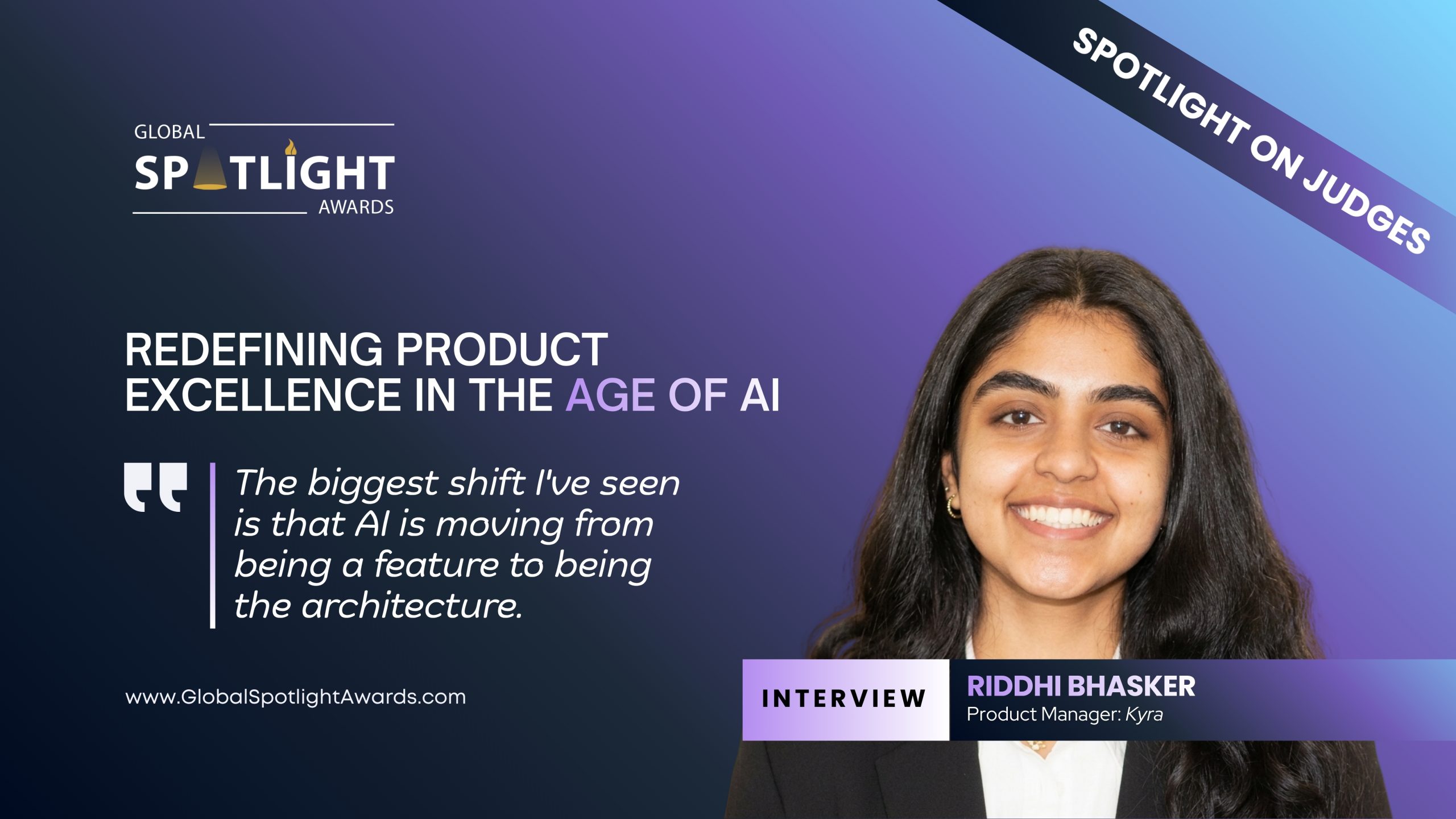
Spotlight on judges: Insights from Riddhi Bhasker, Product Manager
As part of the Global Spotlight Awards 2026, the Spotlight on Judges Series introduces the experts behind the judging process, those shaping what excellence looks like across technology, AI, data, and cybersecurity.
In this edition, we speak with Riddhi Bhasker, Product Manager based in London, whose perspective is shaped by extensive experience in AI-driven products, consumer applications, and early-stage startup innovation.
Riddhi Bhasker specialises in building and scaling AI-powered consumer products, with a focus on engagement systems, retention design, and conversational AI architecture. She has led end-to-end product development across live platforms and emerging AI tools, consistently working at the intersection of product design, intelligent systems, and user behaviour.
An active contributor to the global product and technology community through thought leadership and mentorship, Riddhi brings a highly practical, user-centric perspective to the Global Spotlight Awards 2026 judging panel, centred on what truly defines meaningful innovation in consumer technology.
What does global excellence mean within your field today, and how does it relate to the mission of the Global Spotlight Awards 2026?
Global excellence in product management today isn’t about building the most technically sophisticated product. It’s about building something that genuinely works for real people, in different contexts, across different markets. The products that stand out globally are the ones that solve real problems without making users work too hard to get there, and that earn trust over time rather than just grabbing attention once.
That’s exactly what the Global Spotlight Awards recognise. It’s not about who has the biggest budget or the most press coverage. It’s about meaningful, measurable impact, and that’s the kind of excellence that actually advances the field.
What inspired you to join the Global Spotlight Awards 2026 judging panel, and what value do you believe you bring to the evaluation process?
I joined because I wanted to contribute to recognising innovation that actually matters, not just innovation that looks good in a pitch deck. A lot of what gets celebrated in tech is surface level, and I think there’s real value in having judges who can look beneath that and ask whether something genuinely moves the needle for users.
What I bring is a practitioner’s perspective. I’ve built consumer apps and AI-driven products from 0 to 1, which means I understand the real decisions teams face, the trade-offs between speed and quality, and the difference between a metric that looks good on a dashboard and one that reflects actual user value. I think that kind of hands-on experience makes for more honest and useful evaluation.
How is AI transforming consumer product innovation and user experience at a global level?
The biggest shift I’ve seen is that AI is moving from being a feature to being the architecture. Teams used to ask, “Should we add an AI feature?” Now the better teams are asking, “How do we design the whole system around intelligent behaviour?” That’s a fundamentally different way of thinking about product.
For user experience specifically, the most exciting transformation is personalisation at scale. When AI is well designed, it means the product learns and adapts to you over time in a way that feels genuinely useful rather than creepy. The teams getting this right are the ones who treat memory, context and trust as product problems, not just engineering problems.
What defines a truly successful product in terms of engagement, retention, and long-term value?
A successful product is one where users come back because they want to, not because the product is making it painful to leave. That distinction matters more than most teams realise.
Engagement metrics can lie. High interaction rates often just mean you’ve built a good hamster wheel. The real signal is whether the users who engage are actually finding value, and whether that value compounds over time. Long-term retention comes from a product that earns its place in someone’s life by consistently delivering on its promise, not one that traps users through obligation or manufactured urgency.
The products I respect most are the ones where you can see in the data that users are genuinely better off for using them.
When judging product-led innovation for the Global Spotlight Awards, what key signals indicate excellence?
I look for a few things. First, is the problem real, and is the solution genuinely better than what existed before, not just different? Second, does the team understand their users deeply enough that the product decisions feel inevitable rather than arbitrary? Third, can they show me what changed in user behaviour because of what they built, not just what features they shipped?
The other thing I look for is honesty about trade-offs. The best product teams know what they deliberately chose not to build and why. That level of clarity usually signals a team that really understands what they’re doing.
What future trends in AI-powered consumer products should global innovators be preparing for?
Three things stand out to me. First, memory and continuity. Right now, most AI products treat every conversation as if it’s the first one. The products that will win long-term are the ones that build genuine context over time in a way that feels personal rather than surveillance-like. Getting that architecture right is a hard problem, and most teams haven’t solved it yet.
Second, trust as a product metric. As AI becomes more embedded in daily life, users are going to get better at recognising when something feels off. Teams that invest in explainability, consistency and appropriate human oversight will have a real advantage over those that just optimise for impressive demos.
Third, the shift from AI features to AI behaviour. The question won’t be “does your product use AI” but “does your product behave intelligently in a way that creates real value?” That requires a completely different approach to product design, and the innovators who figure that out early will define the next generation of consumer products.
Closing the Spotlight
Riddhi Bhasker’s perspective reinforces a key theme across the Global Spotlight Awards 2026 judging panel: innovation is only meaningful when it delivers real value to users.
Her focus on usability, trust, and long-term impact highlights the difference between products that capture attention and those that earn lasting relevance. As the awards continue to recognise leaders across technology, AI, data, and cybersecurity, insights like these ensure the judging process remains grounded in real-world outcomes.
About the Global Spotlight Awards 2026
The Global Spotlight Awards recognise individuals and organisations delivering measurable impact across artificial intelligence, technology, data, and cybersecurity. The programme highlights innovation that solves real-world challenges, improves systems, and drives meaningful progress at scale. Through a clear and independent judging process, the awards showcase work that demonstrates strong execution, proven results, and lasting value. By recognising those setting new standards in innovation and performance, the Global Spotlight Awards contribute to a more advanced, secure, and data-driven global future.


