



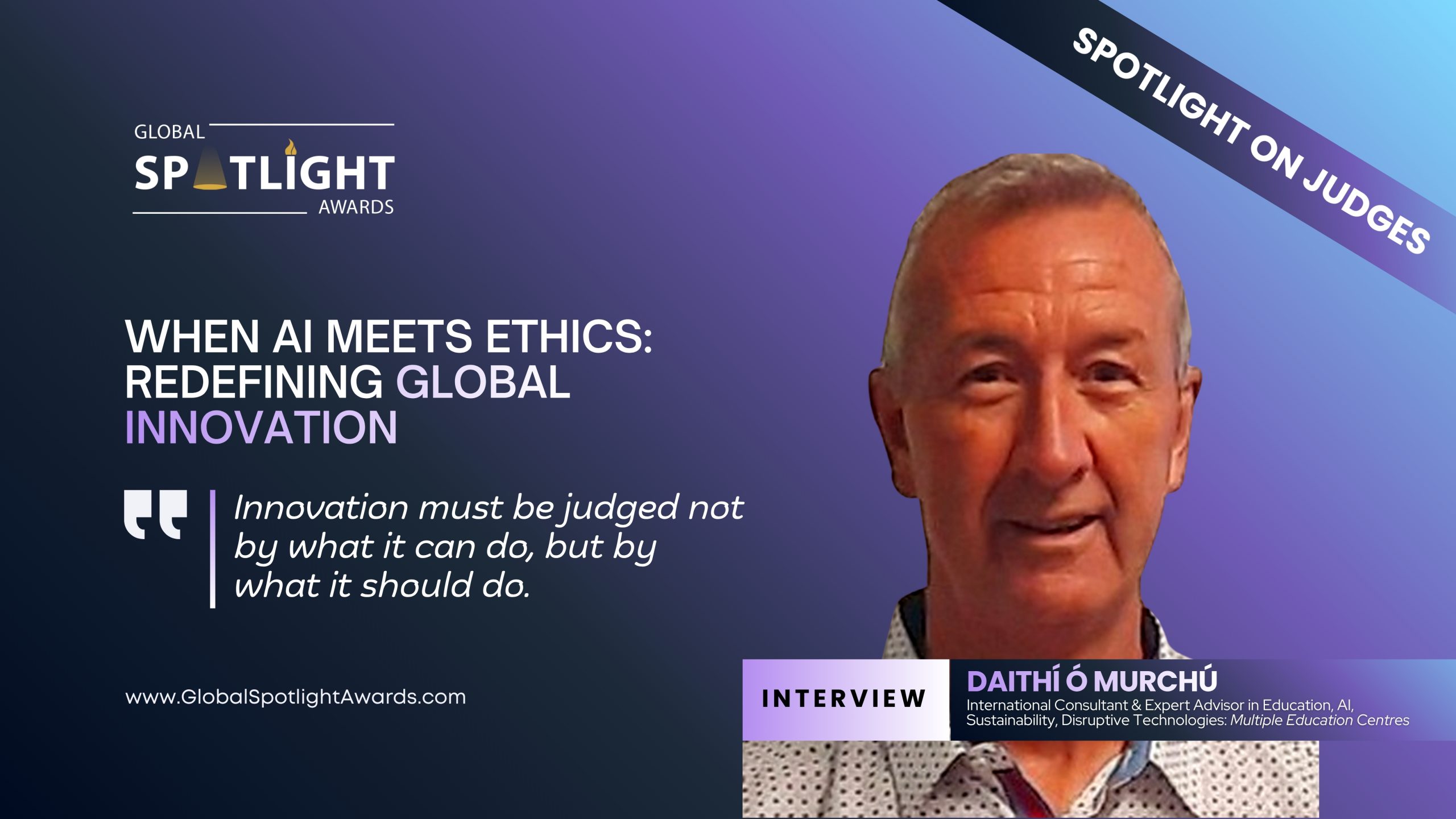
Spotlight On Judges: Insights from Dr. Daithí Ó Murchú,Expert Advisor in Education, AI, Sustainability, and Disruptive Technologies
As part of the Global Spotlight Awards 2026, the Spotlight on Judges Series introduces the experts behind the judging process, those shaping what excellence looks like across technology, AI, data, and cybersecurity.
In this edition, we speak with Dr. Daithí Ó Murchú, International Consultant and Expert Advisor in Education, AI, Sustainability, and Disruptive Technologies, whose perspective is shaped by global work across artificial intelligence, policy, and human-centred innovation.
Dr. Daithí Ó Murchú is an internationally recognised AI thought leader, educator, strategic innovator, and entrepreneur working across artificial intelligence, agentic AI, AI singularity, HumAInology, extended reality AI (XRAI), humanoid robotics, and the future of education, sustainability, citizenship, and human development.
Widely recognised for bridging advanced technology with a human-centred perspective, he brings a distinctive global lens to evaluating innovation. As part of the Global Spotlight Awards 2026 judging panel, he contributes a forward-thinking perspective on responsible AI, global excellence, and the future of human–machine collaboration.
What does global excellence mean within your field today?
Global excellence today is no longer defined by technical advancement alone. It is defined by the extent to which innovation enhances human capability, preserves dignity, and contributes meaningfully to society. In my HumAInological framing, excellence emerges when artificial intelligence works in harmony with human intelligence, not in competition with it. It must be meaningful in its outcomes, mindful in its design, and soulful in its impact. The Global Spotlight Awards have a critical role in recognising not just what is new, but what is right. Excellence must therefore be ethical, inclusive, and sustainable.
What inspired you to join the judging panel?
I joined the panel because we are at a pivotal moment in technological evolution. The shift from assistive AI to agentic AI requires a new form of judgement, one that is grounded not only in technical expertise but in human values. I bring, I hope, a HumAInological lens, grounded in policy, practice, and real-world implementation across diverse, global contexts. My role is to ensure that innovation is evaluated not only for what it can do, but for what it actually should do to change lives positively.
How will advanced AI shape global innovation?
Advanced AI, particularly agentic systems, will redefine how decisions are made, how systems operate, and how knowledge is generated. We are moving towards a world where AI becomes a co-agent in human activity. This presents an immense opportunity, but also a profound responsibility. The question is no longer capability, but governance, ethics, and control. Innovation must therefore be guided by purpose, not driven by possibility alone.
What does responsible AI look like?
Responsible AI is a design philosophy rooted in human primacy. It requires transparency, accountability, inclusivity, and alignment with ethical frameworks such as the EU AI Act and UNESCO guidelines. It is not enough for AI to function; it must function in ways that are transparent, just, sustainable, equitable, and beneficial to society as a whole.
How can innovation create measurable societal impact?
Impact must be evidence-based and grounded in real-world application. It requires implementation science, meaningful metrics, and a focus on human capacity building. In education, this means empowering teachers and learners. In society, it means creating systems that are equitable, accessible, and sustainable.
Role of Global Spotlight Awards?
The Global Spotlight Awards must act as ethical gatekeepers and global standard-setters. They should recognise innovation that advances humanity, not just technology. They have the power to shape the narrative of what excellence looks like in the age of AI.
Sustainability and AIA
A critical dimension that must be foregrounded is the sustainability of AI itself. Artificial intelligence must align with the Sustainable Development Goals, not only in application but in its design and deployment. Green AI, energy-efficient systems, and responsible data practices are essential. AI has the potential to accelerate sustainability efforts globally, from climate modelling to resource optimisation, but only if it is developed with intentionality and responsibility. In this sense, AI must not only be intelligent, but it must be sustainable, ethical, and deeply human-centred.
Closing the Spotlight
Dr. Daithí Ó Murchú’s perspective reflects a defining shift in how innovation is understood within the Global Spotlight Awards 2026: from capability to responsibility, and from intelligence to human-centred impact.
His focus on HumAInology, ethical governance, and sustainable AI highlights the importance of aligning technological advancement with societal good. As the awards continue to recognise leaders across AI, technology, data science, and cybersecurity, insights like these ensure the judging process remains grounded in ethics, purpose, and long-term global value.
About the Global Spotlight Awards 2026
The Global Spotlight Awards recognise individuals and organisations delivering measurable impact across artificial intelligence, technology, data, and cybersecurity. The programme highlights innovation that solves real-world challenges, improves systems, and drives meaningful progress at scale. Through a clear and independent judging process, the awards showcase work that demonstrates strong execution, proven results, and lasting value. By recognising those setting new standards in innovation and performance, the Global Spotlight Awards contribute to a more advanced, secure, and data-driven global future.


