



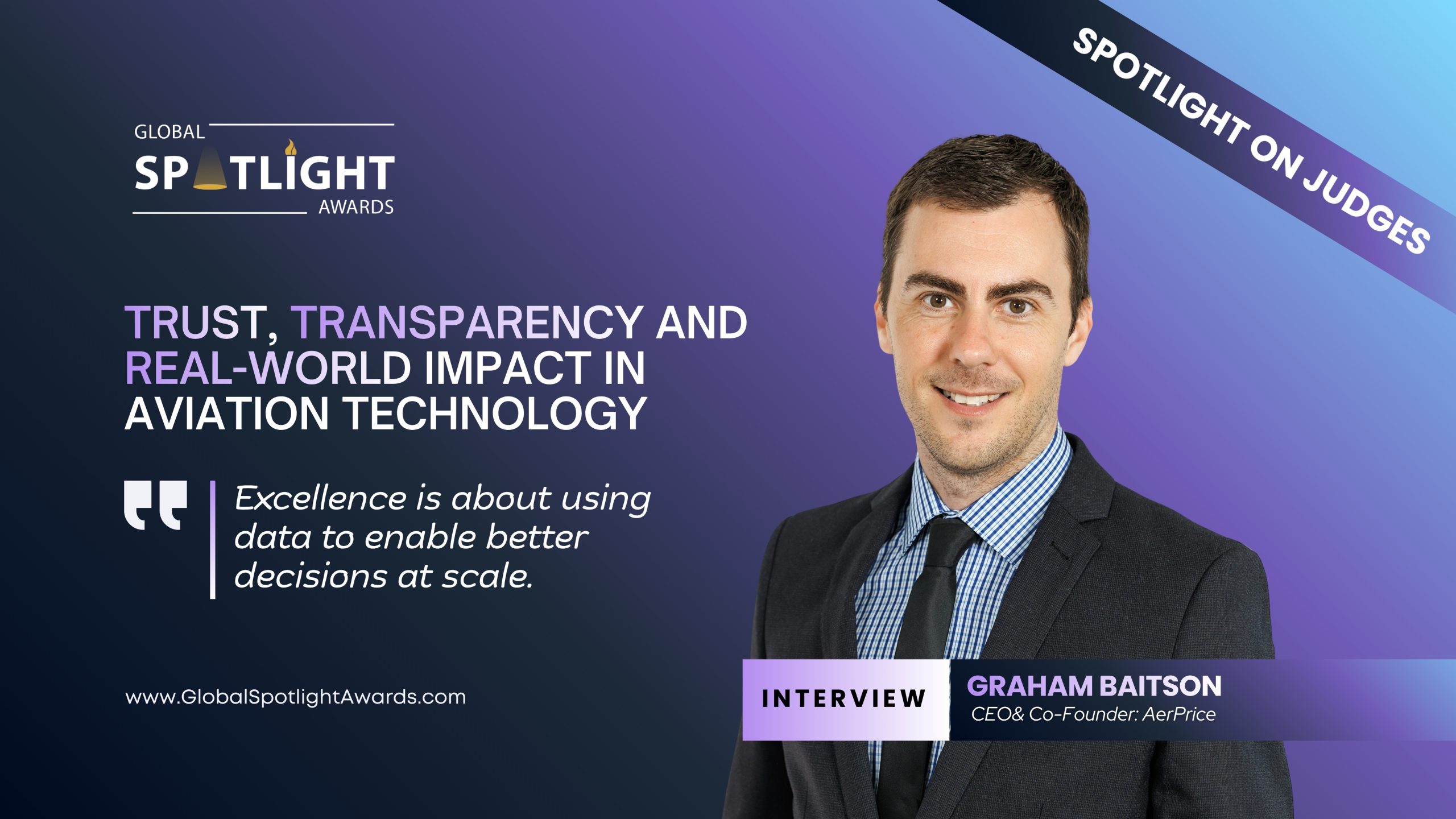
Spotlight on Judges: Insights from Graham Baitson, Co-Founder & CEO, AerPrice
As part of the Global Spotlight Awards 2026, the Spotlight on Judges Series introduces the experts behind the judging process, those shaping what excellence looks like across technology, AI, data, and cybersecurity.
In this edition, we speak with Graham Baitson, who joins the 2026 judging panel, bringing a strong focus on practical innovation, data integrity, and real-world impact.
Graham Baitson is the Co-Founder & CEO at AerPrice, where he leads the development of advanced analytics platforms supporting aircraft investment and fleet decision-making. A technologist and full-stack software engineer, he specialises in building data-driven products that translate complex industry data into clear, actionable decision intelligence.
With experience across both global enterprises and startups, and a deep understanding of how technology performs in high-stakes environments, Graham brings a grounded, commercial perspective to the judging panel, focused on what works, what scales, and what truly delivers value.
What does global excellence mean within your field today, and how does it relate to the mission of the Global Spotlight Awards 2026?
Global excellence in aviation technology is defined by trust, transparency, and real-world impact. When building products, they need to deliver consistent, explainable outcomes in environments where decisions carry significant financial and regulatory consequences.
So for me, excellence is about using data to enable better decisions at scale, with systems that stakeholders can rely on and audit. That’s why initiatives like the Global Spotlight Awards matter. They recognise organisations that aren’t just innovative, but are genuinely improving how industries operate.
What inspired you to join the Global Spotlight Awards 2026 judging panel, and what value do you believe you bring to the evaluation process?
What appealed to me was the focus on meaningful innovation across industries, not just trends. Awards like this play an important role in highlighting solutions that actually move the needle.
I spend most of my time building in a complex, data-heavy environment, so I tend to look at things through a practical lens. Does this actually provide value? Can it scale? Would someone rely on it to make real decisions?
That’s the perspective I bring; cutting through the theory and focusing on real-world applicability, commercial viability, and long-term impact.
How does innovation in complex industries like aviation reflect the global excellence recognised by the Global Spotlight Awards?
Aviation is a good filter for real innovation because there’s no room for error. You’ve got regulation, long asset lifecycles, and significant capital at stake, so anything new has to fit into that reality. It has to work properly, not just look good in a demo.
So when something does succeed in that kind of environment, it usually means it’s robust, well thought through, and genuinely useful. That’s the kind of innovation worth recognising, where technology is actually improving decision-making and outcomes.
What does it take to translate complex data into meaningful decision intelligence at scale?
The hard part isn’t the data, it’s the interpretation. The real value comes from having a clear, structured way of turning inputs into outputs that people can actually act on.
At scale, that means consistency. The same inputs should lead to the same outputs, and the logic behind that needs to be transparent. The challenge isn’t the volume of data, it’s creating clarity from complexity in a way that can be trusted and repeated across different scenarios.
How do you evaluate whether a technology solution is both innovative and commercially viable?
I usually try to answer a few simple questions.
• Does it solve a real, clearly defined problem?
• Can it be deployed reliably in a real-world environment?
• And does it actually create measurable value?
Innovation without commercial viability tends to remain theoretical. The solutions that stand out are the ones that combine technical originality with a clear path from idea to adoption and measurable impact.
What role do emerging technologies like AI play in reshaping operational strategy across industries?
AI is definitely changing how people interact with systems. It’s becoming a powerful interface layer for working with complex data, making it easier to visualise information, generate insights, and analyse different scenarios.
But in highly regulated industries, you still need structured, explainable systems underneath. So I see AI as an enabler; something that improves accessibility and speed, but not a replacement for the core foundations that decisions are built on.
Closing the Spotlight
Graham Baitson’s perspective reflects a consistent theme across the Global Spotlight Awards 2026 judging panel: innovation only matters when it works in the real world. His focus on clarity, reliability, and commercial value highlights what separates strong ideas from solutions that genuinely deliver. As the awards continue to recognise organisations and individuals setting new standards across technology, AI, data science, and cybersecurity, insights like these shape a judging process grounded in substance, not theory.
About the Global Spotlight Awards 2026
The Global Spotlight Awards recognise individuals and organisations delivering measurable impact across artificial intelligence, technology, data, and cybersecurity. The programme highlights innovation that solves real-world challenges, improves systems, and drives meaningful progress at scale. Through a clear and independent judging process, the awards showcase work that demonstrates strong execution, proven results, and lasting value. By recognising those setting new standards in innovation and performance, the Global Spotlight Awards contribute to a more advanced, secure, and data-driven global future.


