



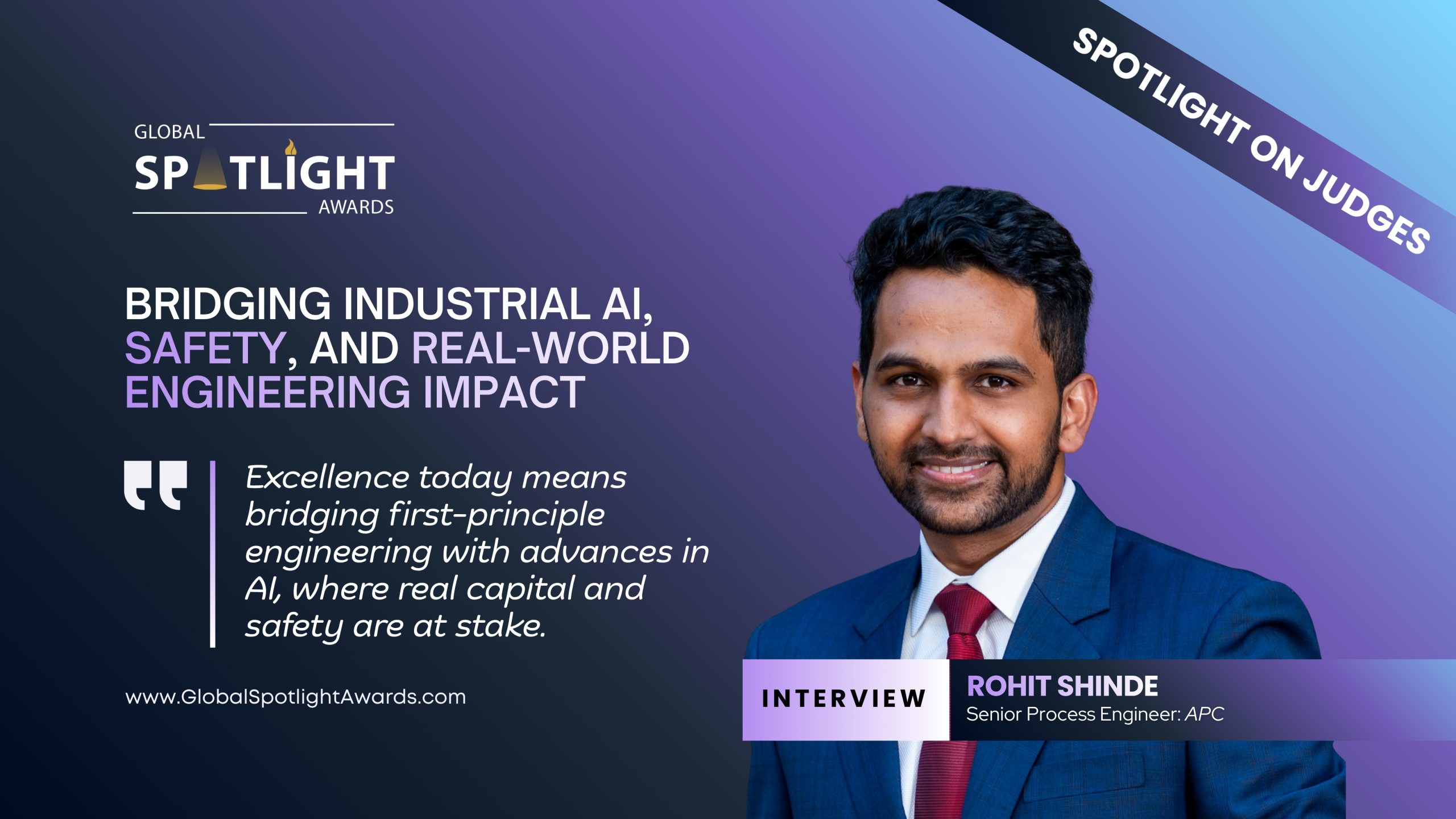
Spotlight On Judges: Insights from Rohit Shinde, Senior Process Engineer, APC
As part of the Global Spotlight Awards 2026, the Spotlight on Judges Series introduces the experts behind the judging process, those shaping what excellence looks like across technology, AI, data, and cybersecurity.
In this edition, we speak with Rohit Shinde, Senior Process Engineer and Independent Researcher, whose perspective is shaped by deep expertise at the intersection of heavy industry, artificial intelligence, and sustainability.
Rohit Shinde is a Senior Process Engineer and Independent Researcher specialising in Industrial AI, sustainability, and large-scale engineering systems. With over a decade of experience managing $80M+ industrial assets, he focuses on the technical and commercial auditing of emerging technologies.
Rohit is a recognised researcher in Industrial AI, with a particular focus on LLM-based engineering copilots and AI-driven safety auditing for complex manufacturing environments. His work bridges technical depth with commercial scalability, ensuring that innovation delivers measurable, real-world impact.
Operating at the intersection of engineering, AI methodology, and sustainability, he brings a highly rigorous, systems-level perspective to the Global Spotlight Awards 2026 judging panel.
What does global excellence mean within your field today, and how does it relate to the mission of the Global Spotlight Awards 2026?
Process engineering is a legacy industry. The workflows, the design tools, and the way decisions get made on a capital project have not changed substantially in decades, and that inertia is not accidental. We deal with catastrophic events when mistakes happen, so the bar for adopting new methods is set correctly high, and the field tends to move more slowly than industries where the stakes are lower.
Whoever has figured out how to bridge first-principle engineering with the recent advances in AI is doing the work that actually defines excellence today. The design itself moves upstream, where it acts as the lever for capital efficiency, safety margins, and emissions performance instead of remaining something to be corrected after commissioning.
What separates excellent work from novelty in this space is straightforward. The contribution has to move real capital, not just benchmark well on a published dataset. It has to hold up inside the safety envelope that governs chemical plants, where a design error can cascade into loss of containment. And it has to bridge AI methodology and first-principle chemical engineering, because work that lives in only one of those domains usually fails at the handoff.
That is why I believe the Global Spotlight Awards 2026 matter. The evaluation crosses those disciplinary boundaries and insists on real-world consequence, and that is what the field actually needs right now: recognition that rewards changing the way work gets done, not incremental progress within a single silo.
What inspired you to join the Global Spotlight Awards 2026 judging panel, and what value do you believe you bring to the evaluation process?
There is certainly an appetite, globally, for engineers to compare notes on how different industries are solving similar problems with AI, and a panel that brings candidates and reviewers together from different geographies and technical backgrounds is one of the few formats that lets that comparison happen at the methodological level. That perspective matters in Industrial AI evaluation, because reviewers who understand machine learning but not hazardous process design, or the reverse, will misjudge work in this category in predictable ways.
The criteria I apply to a submission are specific. Is the contribution original at the methodological level, or is it a known technique applied to a new dataset? Does it hold up under the operating constraints of the target industry, which in this space means regulatory, safety, and economic constraints simultaneously? Has it produced impact beyond the submitting team through independent adoption, citation, or deployment?
What I bring to the panel is the working intersection of current industry practice and AI methodology development. The concrete anchors are LLM-based copilots for automated P&ID generation, a Bayesian-Gaussian framework for precision drug-coating in medical device fabrication, and Green AI applied to IIoT that delivered a GRI-verified 70% reduction in greenhouse gas emissions for targeted industrial processes. I also carry a techno-commercial background, an MBA alongside a decade of engineering consulting, which equips me to evaluate whether a submission is commercially viable and not only technically interesting. From my experience, what survives at the plant scale is a different conversation than what demos well in a paper, and that is the vantage point I expect to add to the panel.
How is Industrial AI shaping sustainable innovation in heavy industry and large-scale operations?
Industrial AI is shifting sustainability from a reporting exercise into a design-time constraint. For most of the last twenty years, emissions, waste, and energy intensity were treated as outcomes to be measured after a plant was commissioned. AI moves those variables upstream, into the stage where the plant is still a set of choices rather than a piece of equipment, and that is where the real sustainability gains live.
Three mechanisms are doing the work. AI-assisted design tools, including LLM copilots for P&ID generation and graph neural networks for equipment sizing, let engineers evaluate hundreds of design alternatives at the conceptual stage and select configurations with materially lower embodied carbon and operating emissions. Green AI applied to IIoT enables continuous optimization of live operations, and in my own work that approach delivered a GRI-certified 70% greenhouse gas reduction for targeted process applications. AI-driven safety auditing, which I am currently advancing, identifies latent hazards in P&IDs before construction, and that reduces both the capital waste of late-stage redesign and the lifecycle emissions associated with rework and incident response.
There is a caveat that has to be stated plainly. Industrial AI itself consumes energy, and responsible deployment in heavy industry requires explicit accounting of the compute footprint against the operational savings claimed. Edge computing and right-sized models are part of how we keep that ledger honest. Work that ignores that balance is not sustainable innovation. It is displaced emissions.
What defines meaningful innovation when balancing engineering complexity, safety, and sustainability?
Meaningful innovation in this field has to satisfy a hierarchy that is not negotiable. Safety is a precondition. Sustainability is a design objective. Complexity is a cost to be minimized, not a virtue to be celebrated. Work that improves sustainability at the expense of safety is not innovation; it is regression, and the engineering community has watched that lesson get re-learned too many times.
Three tests separate meaningful innovation from novelty in my evaluation. The first is the safety-envelope test: does the solution preserve or strengthen the layers of protection that govern the process, or does it introduce new failure modes without commensurate mitigation? The AI-based P&ID safety auditing I am building is designed explicitly to extend, not replace, established hazard-identification practice, and it keeps the human in the loop where the regulator expects one.
The second is the operability test: is a design that is elegant on paper actually operable by the plant workforce? The Bayesian-Gaussian framework I built for drug-coating optimization was designed from the start to produce recommendations that operators can understand and override, because interpretability was a design requirement and not an afterthought.
The third is the lifecycle test: does the sustainability gain survive full-lifecycle accounting across materials, construction, operation, and decommissioning? Innovation that clears all three tests is rare. It is also what the field needs most right now.
How do you evaluate whether industrial AI solutions are truly scalable and impactful in real-world environments?
Four criteria separate demonstration-grade work from deployment-grade work in my evaluation, and I apply them in this order.
Generalisation under domain shift. A solution trained on one plant’s data has to perform acceptably on a different plant with different feedstock, different equipment vendors, and a different control philosophy. Most published Industrial AI work fails this test silently because it is never tested outside its training domain, and that is the gap between a paper and a plant.
Integration cost. Scalability is governed less by the model than by the interfaces around it: DCS, historian, MES, and engineering tools such as Aspen and SmartPlant. A solution that requires bespoke integration at every site is not scalable regardless of how accurate the underlying model is.
Independent adoption. The strongest evidence of real impact is use by parties unaffiliated with the original developers. Citations, third-party deployments, and adoption by EPC contractors outside the originating team are the signals that carry the most weight in my evaluation.
Quantified operational outcome. Impact claims need verifiable metrics tied to the customer’s objectives: throughput, yield, emissions, incident rate. Proxy metrics chosen because they look favorable do not qualify. The 70% greenhouse gas reduction figure from my Green AI/IIoT work is defensible because it is measured against the client’s baseline reporting under GRI standards, not against an internal benchmark.
A solution that scores well on all four is ready for large-scale deployment. Anything less is a pilot, whether the submitting team calls it one or not.
How can global awards like the Global Spotlight Awards help highlight innovation in traditionally under-recognised industries?
Chemical engineering, EPC, and heavy process industries operate with a visibility deficit relative to consumer technology. A data-centre efficiency improvement attracts significantly more attention than an equivalent improvement in a petrochemical complex, even though the latter often has a larger absolute impact on global emissions and material flows.
Global awards correct that asymmetry in practical ways. They create a public record of innovation in sectors that do not generate their own visibility. They attract cross-sector evaluators, which forces submitters to articulate their work in ways that are understandable beyond their own industry, strengthening the work itself. And they signal to funders, regulators, and engineers entering the field that meaningful innovation is happening in industries that rarely make headlines.
For heavy industry specifically, this recognition helps attract talent, build regulatory credibility for AI-assisted systems, and establish the adoption trail that distinguishes durable contributions from one-off projects. The demand for credible recognition exists globally, and platforms like the Global Spotlight Awards play a critical role in meeting that need.
Closing the Spotlight
Rohit Shinde’s perspective brings a sharp and necessary lens to the Global Spotlight Awards 2026 judging panel: innovation must operate within real-world constraints to truly matter.
His focus on safety, scalability, and measurable industrial impact highlights the difference between theoretical advancement and deployment-ready solutions. As the awards continue to recognise leaders across AI, technology, data, and cybersecurity, insights like these ensure the judging process remains grounded in engineering reality, operational performance, and long-term sustainability.
About the Global Spotlight Awards 2026
The Global Spotlight Awards recognise individuals and organisations delivering measurable impact across artificial intelligence, technology, data, and cybersecurity. The programme highlights innovation that solves real-world challenges, improves systems, and drives meaningful progress at scale. Through a clear and independent judging process, the awards showcase work that demonstrates strong execution, proven results, and lasting value. By recognising those setting new standards in innovation and performance, the Global Spotlight Awards contribute to a more advanced, secure, and data-driven global future.


